
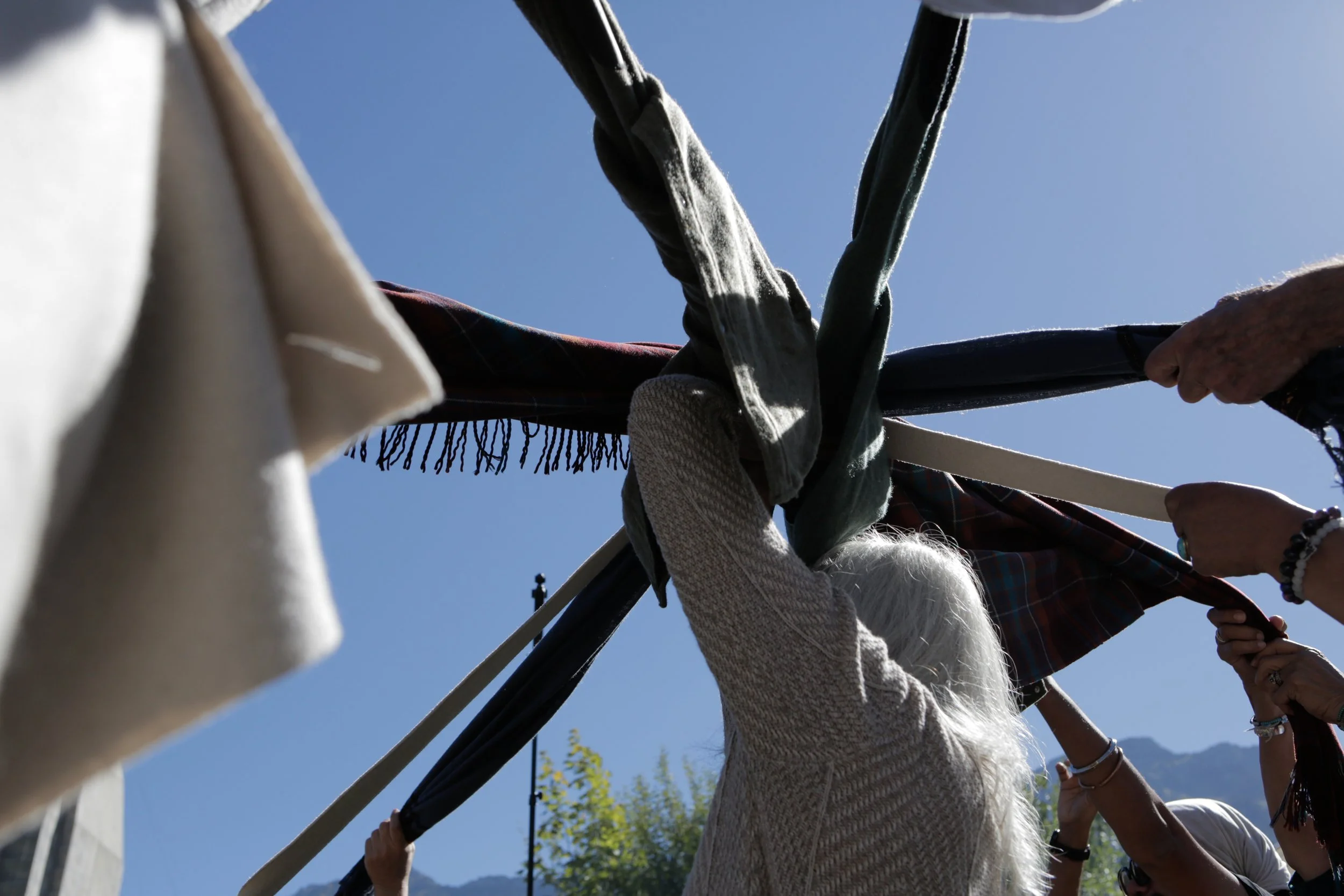
Tighten the Weave
to a question I had not expected to ask: what holds our knowing? A reflection on ancestral memory, the knowledge we have learned to recognise—and the threads we may have forgotten how to see.
September brought me into a succession of gatherings that I am still trying to process.
It began at the World Ayahuasca Forum in Girona, continued with Earthrise in Switzerland, and moved into Interstellar, where some of the elders and wisdom keepers who had gathered remained in conversation with people exploring science, consciousness, health, finance, astrology and the cosmos.
What happened across these gatherings was far greater than anything I could capture here. So many organisations, communities and individuals had spent months, sometimes years, creating the relationships and conditions that made these encounters possible. Everyone who arrived brought something of their own: a history, a body of knowledge, a question, a prayer, a curiosity, a particular way of seeing.
What follows is therefore not an account of these gatherings, nor an attempt to distil everything that was shared. These are simply a few moments that stayed with me—perhaps because they touched questions already moving within me. Someone standing beside me may have witnessed the very same moments and carried home an entirely different story.
There is something humbling in that. We never see the whole weave. We see from where we are standing within it.
And from where I was standing, September seemed to keep asking me about remembering.
The thread I almost missed
At the World Ayahuasca Forum, one of the people who stayed with me most was someone I knew almost nothing about.
A man arrived playing a flute. He appeared European, and something about him made me wonder whether he carried a Gaelic or another European ancestral tradition, although I never asked and do not know. Later, I saw him inside the maloca with swan feathers. Among so many traditions and teachings, there was something almost imperceptible about his presence. Then I watched him leave much as he had arrived, playing his flute.
On the final day, our paths crossed. I told him simply, You were seen.
Something about him had touched a question that has been growing in me for some time.
The Forum had brought together Indigenous peoples from many places, some carrying knowledge and traditions that have survived extraordinary historical pressures. There was something deeply important about their voices being heard and their knowledge being held on their own terms.
And yet, watching this European man move almost invisibly through the gathering, I found myself wondering: where are Europe's wisdom keepers?
And would we recognise them if we met them?
I want to be careful with this question. I am not interested in creating equivalences between histories that are not equivalent, nor in searching for a European version of somebody else's knowledge.
The question feels more intimate than that.
My mother comes from French Polynesia. My father is European. For much of my life, it has been easier for me to recognise an ancestral thread on one side of that inheritance than on the other. One feels visible. The other has often felt more difficult to find.
Living in Switzerland, and increasingly listening differently to the mountains, rivers and places around me, I have begun to wonder whether that thread is actually absent. Perhaps it has simply become harder to see.
Europe has lived through long histories of war, religious conflict, persecution, displacement, industrialisation and profound changes in people's relationships with land, ritual and community. Much has disappeared and much has been transformed. But perhaps some things survived quietly—in food, plants, folklore, pilgrimage, songs, seasonal customs, family gestures and relationships with particular places.
When a thread of transmission has been broken, it does not mean everything has been lost. Some things may simply have survived in forms we no longer know how to recognise.
The man with the flute did not give me an answer. He left me with another question: what if encountering people who have kept their ancestral threads more visible is not an invitation to take those threads, but to begin looking for our own?
A few days later, that question changed shape.
What holds your knowing?
After the Forum had ended, I witnessed an exchange in a more intimate setting between an Indigenous Amazonian medical doctor and a group of scientists. What struck me was the openness on both sides. There was genuine curiosity about what might become possible when different ways of knowing were allowed to enter into conversation.
At some point, the doctor turned the direction of inquiry around. I cannot reproduce her exact words, but what I heard was something like:
What are your own knowledge systems? Where are your elders? Where is the community that holds you accountable for what you create?
The question has stayed with me.
Modern science has developed extraordinary capacities by learning to isolate things. We can identify molecules, observe mechanisms, measure effects and investigate parts of reality with remarkable precision. There is enormous value in this way of knowing.
But her question seemed to come from somewhere else. Not simply What do you know?, but What holds your knowing?
Who carries responsibility for what becomes possible through knowledge? Who remembers the relationships surrounding it? Who asks not only whether something can be done, but how it belongs within a larger living system?
I found myself unable to keep her question directed towards science. It came back towards me.
What holds the things I teach? What holds what has been shared with me? Who am I accountable to when knowledge passes through me and then into another context? What changes when something learned through a relationship with a person, a lineage or a place becomes a methodology, a treatment, a framework or a course?
I don't know. Not yet.
But I find the question increasingly difficult to ignore.
Then came the weave
I met a Spanish wisdom keeper with whom I felt an immediate and difficult-to-explain familiarity. She had created a set of cards after travelling to Machu Picchu, portraying weavers from different civilisations. Among them I found Hina, from my Polynesian inheritance.
I knew Hina, but I had never encountered her through this particular lens: as a weaver.
Then a Peruvian Maestra appeared and sat beside us. It was one of those encounters whose timing felt almost too precise to have been planned.
In her hands was a weave she had made herself. Its pattern was extraordinarily complex, almost more like a map of a living system than a geometrical design. She began to sing as her fingers travelled through the threads, tracing their lines. I had the strange sense that the song and the pattern were not separate things.
I could not read what she was reading. I did not understand what she was showing me. But I remember wondering: where was the knowledge?
Was it in the pattern? Her hands? The song? The making of the weave? What had been transmitted to her? Or was it somehow held in the relationship between all of these things?
The Indigenous doctor's question returned to me: What holds your knowing?
I do not know what the Maestra's weave meant, nor what knowledge it carried, and I would not want to interpret something I do not understand. But I could recognise that I was encountering knowledge differently from the way I had been educated to recognise it.
Much of modern Western understanding begins by separating. A plant becomes its compounds. A body becomes its organs and systems. A song can become frequencies. An organisation becomes departments, roles and metrics. This capacity to differentiate has given us extraordinary knowledge.
Yet watching her hands, I wondered about another capacity: knowing while keeping the relationships between things intact.
Perhaps there are forms of intelligence that become difficult to perceive once we separate the pieces.
Then she looked at me and said something I understood, in that moment, as:
You have to tighten the weave. Hay que cerrar.
I have carried those words ever since.
Weaving is already familiar language in systems change. We speak of network weavers, ecosystem weaving, weaving communities, weaving capital and projects. I use the word myself.
But perhaps I had been using it too lightly.
A weave does not exist because many threads have been gathered in one place. It exists because relationships have been formed between them. Tension matters. Distance matters. Each thread affects the integrity of the whole.
Perhaps tightening the weave does not mean adding more threads.
Perhaps it means tending what passes between them.
Carrying the community
The question followed me from Girona to Switzerland.
At Earthrise in Interlaken, I watched Mama Panchita, an elder of the Mapuche community, share a bag she had woven herself. At first I saw a beautiful woven object. Then she began explaining its patterns.
As I understood her explanation, the motifs represented the different communities of her nation. Each had its place. Woven into the bag was their relationship to one another, their unity and their protection.
She carried them with her.
Until then, I had been thinking about weaving partly as a metaphor. Watching Mama Panchita, I wondered whether calling it a metaphor was already too small.
Perhaps the weave was not simply representing relationship. Perhaps weaving was one of the ways relationship could be remembered and carried.
What also struck me was that unity did not require sameness. The different communities remained distinct within a larger pattern. They did not have to disappear into one another in order to belong together.
That image has stayed with me because it holds a question that reaches far beyond weaving: how do we belong to something larger without losing what makes us distinct?
How do different forms of knowledge meet without one needing to absorb the other? How do we create coherence without demanding uniformity?
How do we weave without erasing the threads?
Did you learn how to weave?
One final conversation in Interlaken brought everything back to a surprisingly simple question.
I was speaking with the wife of one of the Earth Elders about weaving and some of what I had witnessed during those weeks. She shared something with me about the Mapuche understanding of the afterlife. I want to hold this carefully: I am sharing it as it was told to me in that conversation, rather than claiming to speak for Mapuche cosmology more broadly.
As I understood her, when we leave this life, one of the first questions we are asked is:
Did you learn how to weave?
I remember becoming very still.
After everything I had witnessed, the question reached somewhere much deeper than the language of networks, ecosystems or systems change.
I thought of Mama Panchita carrying her communities in the patterns of her bag. The Peruvian Maestra singing as her fingers travelled through the threads. The Indigenous doctor asking what holds our knowledge. The almost invisible European man walking through the gathering with his flute.
Perhaps these stories have nothing to do with one another. Perhaps I am the one weaving them together.
In fact, I almost certainly am.
That is the nature of the mirror. Someone standing beside me may have returned home carrying entirely different threads. These were simply the ones that found me.
But they have left me wondering whether, in systems change, we sometimes pay more attention to the threads than to the weave. We ask what needs to change, what needs to scale, who needs to connect, where resources need to move and which structures need to be redesigned. These are necessary questions.
Perhaps there is another question underneath them.
Are we learning how to weave?
Not simply how to bring more people into the room, but how to tend what exists between us. Not simply how to acquire knowledge, but how to understand what holds it. Not simply how to create new systems, but how to form relationships capable of carrying what we hope to build.
And for those of us whose ancestral threads have become difficult to see, perhaps learning to weave also begins with learning to look again—not by borrowing somebody else's threads, but by becoming curious about what remains of our own.
I don't know where that inquiry leads.
For now, I am carrying the question I was given in Interlaken.
Did you learn how to weave?
PS: Thank you to @melaniepyne for the cover picture for this article, and all the beautiful pictures she took during the Earthrise Collective gathering in Interlaken and the beautiful presence she brings into this world.

The 10,000 Ways We Cheat Ourselves in Systems Change
We can want a different world and still reproduce the patterns of the one we are trying to change. Inspired by a teacher in Egypt who spoke of the “10,000 ways we cheat ourselves,” this essay explores how our hidden patterns around scarcity, recognition, power, service and belonging can quietly enter the gatherings, organisations and systems we create—and why bringing them into consciousness may be one of the deepest practices of systems change.
Years ago, one of my teachers in Egypt said something that has followed me ever since:
“There are 10,000 ways we cheat ourselves.”
He had a particular way of helping people discover them.
Rather than beginning with what we believed about ourselves, he would ask questions designed to bring what was underneath into consciousness.
When was the best period of freedom in your life? The worst?
When did you feel most abundant? When did you feel the greatest scarcity?
What was the best period in your family? What was the most difficult?
What has love felt like at its best? At its worst?
Which relationships nourished you? Which depleted you?
Who were your closest friends? What happened to those relationships?
When did you feel most yourself? When did you abandon yourself?
The precise questions mattered less than what they revealed. He was looking for the distance between the story we consciously tell about ourselves and the patterns our lives actually reveal.
Someone might say they want love while repeatedly choosing unavailable partners. They might long for freedom while constructing a life in which they are indispensable to everyone around them. They might say they want abundance while becoming uncomfortable whenever they receive more than they are accustomed to holding.
We are extraordinarily creative in finding ways to move towards what we consciously want while remaining loyal to something underneath that wants something else.
This was what he meant, I think, by the 10,000 ways we cheat ourselves.
Light workers and light slaves
My teacher also used a distinction that initially made me uncomfortable. He spoke about “light workers” and “light slaves.”
By “light slave,” he did not simply mean someone who had suffered, or someone who still carried wounds. We all do.
He was pointing towards something more subtle: the possibility that even our service, spirituality or desire to change the world can remain organised around an unexamined wound.
We may devote ourselves to healing because we cannot bear our own pain.
We may become indispensable to others because being needed gives us belonging.
We may fight injustice while unconsciously needing an enemy.
We may speak constantly about abundance while organising our lives around scarcity.
We may give endlessly and call it service, while being unable to receive.
We may devote ourselves to creating freedom for others while having very little freedom ourselves.
The outer work can be beautiful. The intention can be sincere. Yet something underneath is still running the pattern.
This distinction stayed with me because I began seeing versions of it everywhere.
First in my Traditional Chinese Medicine practice.
Then in coaching and my work through LifeFlowTao.
And increasingly, in the world of systems change.
Because what happens when the person becomes a collective?
Can an organisation cheat itself? Can a movement? Can a regenerative project? Can a gathering devoted to creating a different world reproduce the very patterns it believes it has left behind?
I think it can.
The wounded change-maker can become the wounded system
If you are reading this, you probably already understand some version of this at the personal level.
The uncomfortable part is recognising that crossing into systems change does not make the pattern disappear.
We bring ourselves with us.
Our wounds around recognition enter our organisations.
Our relationship with scarcity enters our funding models.
Our need to be needed enters our communities.
Our difficulty receiving enters our projects.
Our fear of losing control enters our governance.
Our relationship with power enters the supposedly decentralised networks we create.
Our unresolved competition enters collaboration.
Our hunger for belonging enters the gatherings we organise.
Our need to be seen enters our service.
And because these patterns now operate through noble intentions—regeneration, consciousness, impact, healing, justice, systems change—they can become considerably harder to see.
We can hide from ourselves inside the goodness of what we are doing.
Perhaps this is one of the 10,000 ways.
We say abundance while organising around scarcity
This contradiction has become particularly interesting to me.
In systems-change spaces, we speak frequently about abundance.
Yet scarcity can still organise the field.
There isn't enough funding.
There isn't enough visibility.
There aren't enough investors.
There isn't enough time.
There aren't enough opportunities.
Underneath that scarcity, our perception changes.
The philanthropist becomes a potential donor.
The person with a large network becomes access.
The wisdom keeper becomes legitimacy.
The filmmaker sees a story.
The gathering becomes an opportunity to fundraise.
The collaborator becomes useful because of whom they know.
None of this requires bad intentions. In fact, it can emerge among people with deeply sincere intentions. But scarcity creates urgency, and urgency can gradually transform relationship into utility. The pattern I observed in a recent systems-change inquiry was striking: scarcity can lead to urgency, insufficient preparation, overextension, control, instrumentalisation and eventually relational rupture.
This is where my teacher's question becomes interesting at the collective level.
Instead of asking only:
What kind of financial system do we want to create?
Perhaps we also need to ask:
When did this project last feel abundant? When did it feel most afraid? How do we behave when funding becomes uncertain? What happens to our relationships when there is not enough?
The answers may tell us more about the system we are actually creating than our theory of change does.
We speak about decentralisation while needing to remain central
This is another beautiful place to cheat ourselves.
We want networks rather than hierarchies.
We want distributed leadership.
We want ecosystems.
We want people to step into their agency.
Until they do.
Someone we have mentored develops their own voice.
A collaborator creates relationships independently of us.
People begin going directly to someone we introduced them to.
Another person's idea receives more attention than ours.
Suddenly something contracts.
Again, this doesn't necessarily mean we are selfish.
It may mean that our identity has become entangled with our position in the system.
I am the founder.
The connector.
The visionary.
The healer.
The person who brought everyone together.
The one who understands the field.
The one who helps.
And if another person's flourishing changes my position, I discover whether my belief in abundance has reached the deeper layers of myself.
One of the most interesting questions emerging from our recent work has been whether we can support another person's gifts not only when those gifts strengthen what we are building, but when they allow that person to become more autonomous, visible and influential than we expected.
Perhaps the systems-change version of my teacher's question is:
When was the last time somebody else's success genuinely expanded you? When did somebody else's visibility make you contract?
Not what do you believe about collaboration?
What actually happens inside you when the relational field changes?
We serve because we need to be needed
This may be where the idea of the “light slave” becomes particularly uncomfortable.
Systems-change spaces attract extraordinary people who want to contribute.
We connect.
We facilitate.
We fund.
We heal.
We advise.
We organise.
We hold.
We give.
But there is a question underneath all of this that I increasingly find important:
Who am I when nobody needs what I have to offer?
Can I enter a gathering without becoming useful?
Can I listen without preparing my contribution?
Can I allow someone else to hold the centre?
Can I encounter a problem without needing to solve it?
Can I belong without demonstrating my value?
Our harvest revealed how contribution itself can become identity: doing good brings recognition; recognition creates a sense of place; and eventually the absence of a role can produce a surprisingly deep uncertainty about who we are.
This doesn't make service wrong.
It asks whether our service is free.
There is a profound difference between having something to give and needing someone else to need it.
Perhaps the “light worker,” in my teacher's language, is not the person who does more good.
Perhaps it is the person whose contribution is becoming increasingly free from the wound that once made contribution necessary.
We create freedom through structures that exhaust us
This pattern fascinates me because I have seen versions of it in both bodies and organisations.
We organise a gathering about regeneration and exhaust the organising team.
We build a movement for a slower, more relational world through relentless urgency.
We create a project about abundance while its founders work unpaid.
We advocate decentralisation while one person carries all the responsibility.
We speak about listening while filling every available hour with content.
We create transformational experiences without creating enough space afterwards for transformation to take root.
In my TCM practice, I often meet the equivalent pattern in the body.
Someone wants health so badly that healing becomes another project to optimise.
They add meditation, exercise, supplements, treatments, breathwork and a better morning routine to an already overloaded life.
Even rest becomes something to accomplish.
The content changed.
The pattern didn't.
Systems can do exactly the same thing.
We can build the new world with the metabolism of the old one.
A gathering may produce extraordinary experiences and still lack the relational infrastructure required to carry what those experiences awaken. Experience is not automatically transformation; there needs to be a return movement of integration, response, commitment and giving back.
Perhaps one of the clearest ways we cheat ourselves is by changing what we do without changing the pattern through which we do it.
Bringing the system to consciousness
This brings me back to my teacher's questions.
Their purpose was not judgement.
It was consciousness.
You cannot work with a pattern you cannot see.
Perhaps our organisations, movements and gatherings need similar questions.
Not another impact assessment. Not another set of values for the website. Questions that reveal the distance between what we say we are creating and what people actually experience.
We might ask:
Abundance: When does money make us contract? What would “enough” actually be? If ten times more resources arrived tomorrow, could we receive and steward them?
Power: Who becomes more powerful through what we are building? Who becomes more dependent? What happens when someone no longer needs us?
Relationship: Which relationships would we still tend if they offered us no funding, introductions, legitimacy or opportunity?
Voice: Who speaks easily in our spaces? Who becomes quiet? Do we mistake giving everyone the same space for creating the conditions in which everyone can actually be heard?
Service: Are we responding to what is needed, or to our need to contribute? Can we remain present when our expertise is not required?
Reciprocity: Who is carrying the work? Who is receiving? Is there genuine circulation, or have we confused generosity with reciprocity?
Timing: Are we allowing something to develop at the pace it requires, or is our anxiety creating urgency and calling it momentum?
Ownership: If something beautiful emerges through the relationships we convened, do we need it to belong to us?
Impact: Are we only measuring what we produced, or whether the relationships, agency and living system became stronger through our presence?
Integrity: Where is the system we say we want most contradicted by the way we are currently behaving?
These questions are not meant to prove that we are secretly bad people.
They are ways of bringing the felt reality of the system into consciousness.
Because there is an enormous difference between saying we believe in reciprocity and asking the people around us whether they actually experience reciprocity.
There is a difference between saying we are decentralised and noticing where decisions really accumulate.
There is a difference between talking about abundance and examining what happens to us when resources, recognition or opportunity become scarce.
And there is a difference between wanting to change a system and becoming conscious of the ways that system still lives through us.
The 10,000 ways are not the problem
I no longer hear my teacher's sentence pessimistically.
If there really are 10,000 ways we cheat ourselves, we will probably never become perfectly conscious of all of them.
Nor do we need to.
The practice is noticing the next one.
This is something Traditional Chinese Medicine continues to teach me. A symptom is information. Rather than immediately trying to eliminate it, we can ask what pattern it is revealing about the whole.
Perhaps our contradictions deserve the same curiosity.
When competition appears inside collaboration, it is information.
When scarcity appears inside an abundance project, it is information.
When hierarchy reappears inside decentralisation, it is information.
When exhaustion appears inside regenerative work, it is information.
When being needed becomes inseparable from serving, it is information.
When another person's flourishing threatens our place, it is information.
When a gathering about transformation becomes another experience we consume before moving to the next one, it is information.
These moments are not interruptions to systems change.
They may be where systems change actually begins.
Because perhaps there are light workers and light slaves not only within spiritual practice, but within our organisations, movements and systems too.
A project can be devoted to liberation while still organised around a wound.
A movement can speak the language of abundance while metabolising scarcity.
A gathering can celebrate relationship while unconsciously instrumentalising people.
A regenerative organisation can reproduce extraction through the way it treats its founders, employees or collaborators.
And a person can devote their life to changing the world while quietly recreating the conditions from which they themselves are trying to become free.
The deepest harvest for me has therefore become less about designing the perfect new system.
It is about developing the capacity to notice what is actually moving through the one we are creating. Our recent inquiry began with questions about finance, but repeatedly returned to the same insight: what is missing is often the living relational architecture that allows money, wisdom, responsibility and relationship to meet without one consuming, controlling or instrumentalising another.
Maybe this is what my teacher was pointing towards all those years ago.
We do not cheat ourselves because we don't want change.
Sometimes we cheat ourselves because one part of us is reaching towards the new while another is still organised around what it learned in the old.
The same may be true of systems.
So perhaps, alongside asking What future are we trying to create?, we need another question:
What are we still unconsciously asking the future to heal, validate or provide for us?
And perhaps the work begins there—not in becoming perfectly healed before we act, but in bringing enough of what is moving underneath into consciousness that we no longer need to build our wounds into the systems we hope will set us free.

Once We Enter the Room
What if some of the qualities we learned to suppress in order to be taken seriously are precisely the qualities leadership now needs? This essay explores Yin and Yang in leadership—not as gendered qualities, but as complementary forms of human intelligence—and asks what becomes possible when we stop equating strength with carrying, control and constant action, and begin integrating the capacities to sense, nourish, receive and relate with the precision to decide, act and bring resources into the whole.
On Yin, Yang and a wider understanding of leadership
For many years, I have accompanied leaders, entrepreneurs and investors through initiatory journeys in Egypt. One of the questions that has followed me from those journeys is what sovereignty looks like when it is no longer confused with control.
That question became particularly alive for me at Hatshepsut’s temple. At the time, I was exploring how to inhabit authority without imposing, controlling or withdrawing. Standing in a place created by a woman who held enormous power opened another possibility: perhaps sovereignty is not primarily about how much we can command, but about what becomes possible around us because of how we hold power.
Since then, through my work with leaders and through my practice of Traditional Chinese Medicine, I have watched this question take many different forms.
Women fought extraordinarily hard to enter rooms from which they were historically excluded. They became executives, founders, investors, board members and decision-makers. That movement matters, and it is far from complete. But I wonder whether another stage of that journey is now asking for our attention.
Once we have gained access to the room, do we want to reproduce the logic that created the room?
Although women’s experience is an important part of this inquiry, this is not an essay about how women should lead. When I speak about the feminine, I am speaking about what Taoist philosophy associates with Yin: receiving as well as initiating, sensing as well as analysing, allowing as well as directing, nourishing rather than only producing, and understanding relationship as a form of intelligence.
These capacities do not belong to one gender. They are human capacities. I have worked with men who have a deep relationship with them and women who have learned to almost completely override them. For some women, there is a particular history of suppressing these qualities in order to be taken seriously in environments that rewarded a different expression of power. For some men, they may be capacities they were rarely encouraged to develop or express. For people whose experience of gender does not fit that binary, the relationship will be their own.
What interests me is not who is supposed to embody which qualities. It is what happens when any of us becomes cut off from part of our intelligence because it does not fit the prevailing image of a strong leader.
The Intelligence the Room Recognises
For many people entering positions of power, success requires becoming exceptionally fluent in the qualities our institutions already recognise as leadership: decisiveness, rationality, stamina, productivity, certainty, the ability to absorb pressure and keep performing.
We need these capacities. The question is what happens when they become our dominant definition of competence.
What happens to our ability to notice what is not being said in a meeting, even when everyone appears to agree? To sense that trust between two people has shifted before it becomes an open conflict? To recognise that not everything in an organisation moves at the same speed: capital can be deployed in a day and a strategy changed in a meeting, while trust, capability, culture and a new idea may need much longer to mature?
What happens to our ability to recognise when forcing an emerging idea prematurely into targets, deliverables or a business model will constrain rather than strengthen it? To see a capacity in someone before it is visible in their performance and create enough room for them to grow into it? To recognise when pushing harder might deliver the immediate objective while quietly damaging the people and relationships on which the longer-term work depends?
These are also forms of intelligence.
Because they are harder to quantify, however, they can be easier to dismiss as subjective, emotional or insufficiently rigorous. We can become highly trained in the forms of intelligence the room already recognises while gradually losing confidence in our ability to perceive what does not yet appear on the dashboard.
I see this particularly with women who have spent years learning how to succeed in environments where credibility depended on being able to explain, demonstrate and defend what they knew. They sense something, then immediately search for the data that will give them permission to trust what they sensed.
The point is not to replace analysis with intuition. Intuition can be wrong. So can a financial model. The opportunity is to recover a fuller range of intelligence with which to lead.
Carrying Is Not the Same as Nourishing
I see the consequences of our ideas about strength every week in my TCM practice.
I never set out to specialise in burnout. In many ways, burnout found me. For the past ten years, people have arrived with different symptoms and different stories, yet underneath them I have encountered remarkably similar patterns: interrupted sleep, locked jaws, tension across the shoulders, digestive issues, exhaustion that rest alone does not resolve. Bodies that have become very good at continuing long after something was asking them to change.
I see this particularly often in women carrying significant responsibility. They may be holding a company or a team while also holding a family, a relationship, the emotional needs of others and the countless details that make everyday life function. Many are extremely capable. That capability can become its own trap: because they can carry so much, more continues to be placed upon them—and often they place more upon themselves.
We have learned to associate this capacity with strength.
Our dominant Western image of the strong leader is still often the person who absorbs pressure without being destabilised by it: the one who has the answer, makes the difficult decision, remains available when things go wrong and steps in when nobody else knows what to do. In a crisis, these qualities can be invaluable. But when they become a permanent way of leading, they create a particular kind of organisation around them.
If I am always the one who knows, decides, resolves and reassures, the people around me have fewer opportunities to develop their own judgement, confidence and authority. My ability to carry can inadvertently teach the system to depend on my carrying.
What looks like strong leadership can quietly prevent strength from developing elsewhere in the system.
This is where the distinction between carrying and nourishing has become important to me.
Carrying says: I will hold this.
Nourishing asks: What does this need in order to develop its own capacity?
They can look similar from the outside, but they create very different systems. Carrying can make the leader increasingly indispensable. Nourishing gradually makes more people capable.
Sometimes nourishing means providing very clear direction. Sometimes it means resisting the impulse to provide the answer. It can mean recognising someone’s capacity before they recognise it themselves and giving them a real opportunity to exercise it. It can mean protecting an idea that is not yet ready to be scaled, setting a firm boundary, asking for support, or having enough trust to stop interfering.
And this is an important distinction when we speak about Yin: nourishing does not mean endlessly giving. A person who continually gives while becoming depleted is not participating in a regenerative relationship. They are carrying.
Healthy Yin Needs Healthy Yang
None of this is an argument for less Yang. A living system needs both.
Healthy Yang can be extraordinarily precise. It focuses. It decides. It protects. It negotiates. It closes the deal. It takes something that exists as possibility and gives it form.
There are moments when a leader needs to stop exploring and act. The financing needs to be secured. The contract needs to be signed. A boundary needs to be made clear. Someone needs to take responsibility for a decision. An organisation cannot remain indefinitely in emergence.
There is nothing inherently extractive about this kind of force. The more interesting question is what that force is serving.
I sometimes think about the precision of a predator. The moment of the kill is concentrated and uncompromising: attention, timing, speed and commitment. Yet within a healthy ecosystem, that act does not exist in isolation. The predator feeds, other species feed from what remains, microorganisms participate in decomposition, and nutrients eventually return to the soil. What appears at one scale to be an act of taking participates, at another scale, in a much larger circulation of life.
Healthy Yang in leadership can operate in a similar way. A founder may pursue a deal with extraordinary determination, but the capital brought into the organisation can become salaries, infrastructure, experimentation and the resources that allow other people to bring their gifts into the world. An investor can be rigorous about performance while understanding that healthy returns allow capital to circulate towards other people, places and ideas.
Healthy Yang concentrates energy so that the larger system can be resourced.
The problem begins when concentration becomes accumulation—when resources continually move towards one part of the system without circulating back through the relationships that made their creation possible.
And I don't think this pattern only shows up in how we relate to money.
I increasingly notice it in how we relate to one another.
I attend many gatherings of entrepreneurs, investors and leaders, from intimate retreats to places like the World Economic Forum. These spaces bring extraordinary people together, and meaningful collaborations can emerge from them. Yet I often leave tired by a particular quality of interaction that has become increasingly normalised.
Sometimes networking begins to feel strangely like Tinder.
Within a few minutes, we are unconsciously swiping left or right. Can you fund me? Can I make something out of your idea? Who do you know? Can you introduce me to someone? Is this conversation worth my time?
There is nothing wrong with seeking investors, partners, clients or opportunities. Bringing resources and ideas together is part of what these gatherings are for. Healthy Yang does exactly this: it recognises possibility and acts upon it.
But something changes when relationship becomes primarily a means to an outcome.
We stop encountering the person in front of us and begin evaluating their usefulness.
And perhaps this is where the distinction between transaction and relationship matters. A transaction asks what we can exchange. A relationship contains possibilities that neither person can necessarily see at the beginning.
Some of the most important relationships in my own life would probably have failed a five-minute assessment of their strategic value. Their significance became visible through time, trust, disagreement, generosity, coincidence and experiences neither of us could have planned when we met.
If we only invest in relationships whose return we can already see, we may be applying the same extractive logic to one another that many of us are trying to move beyond in our organisations and economies.
This is where healthy Yin becomes essential.
Yin allows us to remain in relationship before knowing what the relationship will produce. It perceives the larger field in which an action is taking place. In an organisation, it notices whether the pace of growth is exhausting the team, whether the conditions attached to capital are pulling the company away from its purpose, whether trust between partners is deteriorating, or whether an idea needs more time before being scaled.
This relational intelligence does not oppose results. It asks us to perceive the conditions producing them.
A company can hit its targets while its founders lose trust in one another. It can raise significant capital while gradually compromising the purpose for which it was created. It can grow quickly while depleting the people responsible for sustaining that growth. Equally, a leader can spend so long sensing, consulting and waiting for alignment that an opportunity passes because nobody was willing to decide.
Both tell us something about imbalance.
Healthy Yin without sufficient Yang may perceive what is needed but struggle to bring it into form. Healthy Yang without sufficient Yin can become extraordinarily effective at reaching an objective while losing awareness of what that achievement is costing the wider relational field.
The point, then, is not to become more feminine.
It is to become more whole.
Perhaps mature leadership is the capacity to move between these intelligences. To listen deeply and then act precisely. To allow something to emerge and recognise when the moment has come to give it form. To nourish without carrying. To receive without becoming passive. To pursue resources without confusing concentration with accumulation. To build relationships without immediately demanding that they become useful.
This is increasingly the territory that interests me in my work with leaders. Not how to become a better leader according to an existing definition of leadership, but what becomes possible when we begin to notice the patterns around which our leadership has been built.
What happens when the person who always knows allows themselves not to know long enough for someone else’s intelligence to enter? When the person who always carries creates the conditions for others to develop their own strength? When someone who has spent years overriding their sensitivity begins treating what they perceive as information alongside analysis and evidence? And when someone who is naturally receptive discovers that the most life-serving response in a particular moment is to become extremely precise, make the decision and close the deal?
These shifts are difficult to make intellectually. We can understand them perfectly and continue reproducing the same patterns. They have to become embodied.
Perhaps that is why I keep returning to the language of initiation. There are thresholds in leadership that cannot be crossed simply by accumulating more knowledge. Sometimes the qualities that made us successful become so familiar that we mistake them for the whole of who we are.
Women fought hard to enter the room. We should never diminish what that required. But perhaps the next question belongs to all of us:
What did we learn to leave outside in order to belong there?
For some women, the answer may include sensitivity, intuition, receptivity or the ability to receive support without experiencing it as weakness. For some men, it may involve discovering that these same capacities do not diminish strength. For others, the journey will not fit either of these stories.
We do not necessarily need to become harder. We do not need to prove how much more we can carry. And we do not need to reproduce a narrow model of power in order to stand fully in our authority.
Perhaps the work now is to become capable of accessing more of ourselves: the part that can sense the field and the part that can act within it; the part that can nourish and the part that can protect; the part that can remain with another person without needing anything from them, and the part that can recognise the moment when a relationship is ready to become collaboration; the part that knows how to receive and the part that can go out into the world, gather resources and bring them back to nourish the larger ecosystem.
Perhaps some of the intelligence we learned to leave outside the room is precisely what we now need in order to lead differently once we are inside it.

What We Have Yet to See
Every civilisation develops its own way of seeing the world. Those ways of seeing illuminate some forms of intelligence while obscuring others. This article explores what becomes possible when we question the assumptions through which we understand one another.
There are certain ideas that become so familiar that we eventually stop experiencing them as ideas at all. They quietly become part of the architecture through which we interpret reality. Not because they are unquestionably true, but because they shape the questions we ask before we even realise we are asking them.
Perhaps the same is true of civilisations.
Every civilisation develops its own way of understanding the world. It cultivates particular forms of knowledge, values certain kinds of intelligence, and creates categories through which reality becomes meaningful. These categories allow us to make sense of the world around us. But they also shape what we are capable of recognising.
This leaves me with a question that has stayed with me for several years.
Can one civilisation ever fully understand another without first questioning its own assumptions?
History suggests the answer is more complicated than we might like to believe.
When Europeans first encountered many Indigenous societies, they often concluded that these cultures lacked science, governance, philosophy or sophisticated systems of knowledge. Over time, it became clear that these things had been present all along. They simply did not resemble their European equivalents. The limitation was not necessarily in the cultures themselves. It lay, at least in part, in the assumptions of those doing the observing. They were not simply interpreting another civilisation; they were interpreting it through the categories of their own.
That pattern makes me wonder how often we continue to do the same thing today.
One place where this question becomes particularly interesting is within developmental frameworks such as Spiral Dynamics.
One of the ideas these models explore is that, as individuals and societies develop, we become increasingly capable of recognising interconnectedness. We begin to move beyond seeing isolated parts and instead perceive relationships, systems and living wholes. This shift has profoundly influenced contemporary thinking in leadership, organisational development and systems change.
But reading the model through the lens of this broader question led me somewhere unexpected.
If our own civilisation has only relatively recently begun to articulate interconnectedness in this way, what assumptions did we bring when we first encountered cultures that had organised themselves around this understanding for centuries?
Were we capable of recognising what we were looking at?
Or were we simply not there ourselves?
Over the past several years, I have had the privilege of spending time with Indigenous Elders from different parts of the world. Again and again, I encountered cultures in which relationship was not simply one value among many. It was the organising principle of life.
Human wellbeing was inseparable from the wellbeing of the land. Healing extended beyond the individual to include family, community and the wounds carried across generations. Governance was rooted in reciprocity rather than control. Decisions considered not only those living today, but also those who came before and those yet to come.
These were not philosophical ideals.
They were simply how life was organised.
Looking back, I find myself wondering whether European observers could have recognised this.
If they had not yet developed concepts such as systems thinking, ecology or interdependence, perhaps they naturally focused on what they could recognise instead: kinship structures, ceremony, oral traditions and tribal organisation. Those became the defining characteristics through which many Indigenous cultures were understood.
But perhaps something else was present that remained largely invisible.
Not because it was hidden.
But because the observers had not yet developed the assumptions—or even the language—required to recognise it.
If that is true, then something important follows.
Development may not only change how we think.
It may also change what we are capable of seeing.
As our own civilisation has become more capable of thinking systemically, we have also become more capable of recognising forms of relational intelligence that may always have been there. What appears to us today as a sophisticated understanding of interconnectedness may not always be something humanity has only recently discovered. Sometimes it may simply be something we have only recently become capable of recognising.
Perhaps what has changed is not them.
Perhaps what has changed is us.
This shifts the question entirely.
Instead of asking where another civilisation belongs within our models, perhaps we should first ask whether our models are capable of recognising everything that another civilisation has developed.
This is not only a question for developmental frameworks. It is a question for every framework we inherit.
Every framework reflects the assumptions of the civilisation that produced it. Every way of seeing illuminates certain aspects of reality while leaving others in the background. The challenge is not to find the one framework that explains everything. It is to remain aware that our own perspective is always partial.
Perhaps every civilisation carries a piece of a much larger human story.
The future may depend less on deciding which civilisation understood the world most completely, and more on developing the humility to recognise that there may always be forms of intelligence lying just beyond the horizon of our own assumptions.
Because the greatest limitation may not be what we know.
It may be what we have yet to see.

Time is Art
What if time is not a resource at all, but a relationship? In a culture that teaches us to save, spend and optimise every hour, we often find ourselves feeling perpetually behind. This essay explores how reconnecting with rhythm, presence and the living world may change not only our experience of time, but our experience of life itself.
We have never been better at measuring time.
Our calendars organise our days months in advance. Our watches count our steps, monitor our sleep and remind us when to stand up. We have built entire industries around helping us save time, manage time and become more productive.
Yet despite all of this, one sentence has become almost universal.
"I don't have enough time."
It is one of the defining expressions of modern life.
This has always struck me as a strange paradox. Every technological breakthrough promised to give us more time. Faster transport. Instant communication. Artificial intelligence. Automation. If saving time were the answer, surely by now we would feel less rushed than any generation before us.
Instead, many people experience exactly the opposite. They move from one commitment to the next with the quiet feeling that they are always behind. There is always another email to answer, another opportunity to pursue, another course to complete, another version of themselves they imagine they should already have become.
One of the most powerful stories modern civilisation tells is that time is something we can own, manage and spend. We invest it, waste it, save it and lose it, as though it were another form of currency moving through our lives.
But what if time is not a resource at all?
What if it is a relationship?
That possibility changes the question entirely.
If time is something to possess, then every moment that slips away feels like a loss. If time is a relationship, however, the quality of our attention matters far more than the quantity of our hours.
This is a pattern I encounter repeatedly in my work.
People rarely arrive because they genuinely lack time. They arrive because they have become disconnected from their own rhythm. They compare the pace of their business with someone else's. They feel they should be further ahead. They carry expectations that were never really their own. Even moments of rest become uncomfortable because they believe they should be doing something more useful.
During my years practising Traditional Chinese Medicine, this pattern became especially clear.
The question I heard most often from patients experiencing burnout was remarkably consistent.
"How long will it take before I can go back to my old life?"
My answer was almost always the same.
"As long as it takes for you to change your old way of living."
People were often surprised by that answer.
They assumed healing meant returning to the person they had been before burnout. Yet it was often that very way of living—the constant striving, the perpetual urgency, the belief that they were somehow behind—that had brought them to this point.
Healing was never about recovering enough energy to resume the same life.
It was about learning to live differently.
And that kind of transformation cannot be measured by the calendar.
It unfolds according to its own rhythm.
Perhaps this is something we have quietly forgotten.
Relationships cannot be accumulated or optimised. They deepen through attention. Anyone who has spent time with a child recognises this instinctively. Children are rarely concerned with whether an afternoon has been productive. They disappear completely into whatever captures their imagination. An hour becomes a world because they are fully inside it.
The same happens when we become absorbed in creating something we care about. We lose track of time not because it disappears, but because our attention is no longer divided between where we are and where we imagine we ought to be.
Perhaps this is why artists have always understood something that modern culture struggles to remember.
A painting cannot be rushed into maturity. A musician cannot force rhythm. A potter cannot hurry clay beyond what it is ready to become. Creation asks for patience, sensitivity and a willingness to work with what each moment offers rather than against it.
Living systems move in much the same way.
No forest measures success by how quickly it grows. Rivers do not compare themselves with one another. Spring does not arrive early because winter feels behind schedule. Everything participates in rhythms that belong to the whole.
Somewhere along the way, we exchanged rhythm for schedule.
That exchange has brought extraordinary achievements. Clocks and calendars allow us to coordinate across continents, organise complex societies and collaborate in ways previous generations could scarcely imagine.
But every invention carries a hidden cost.
When the calendar becomes more real than the season, when efficiency becomes more important than attentiveness, when our worth is measured by how much we accomplish rather than how deeply we inhabit our lives, something essential begins to fade.
Perhaps this is also why moments of synchronicity often appear when we finally stop trying to force everything into place.
Not because life suddenly changes.
But because our relationship with it does.
We begin to notice what has been quietly present all along.
There is a profound difference between living according to the clock and living according to rhythm.
One leaves us constantly asking whether we have enough time.
The other invites us to ask whether we are fully alive to the time we have.
Perhaps that is what I mean when I say Time is Art.
Not that life should become slower or less disciplined.
But that a life well lived cannot be measured only by what fits into a calendar.
Like any work of art, it is shaped by attention, relationship and the courage to trust that not everything meaningful unfolds according to a schedule.

The Fear of Endings
Some of the most important challenges of our time appear completely unrelated. Our obsession with longevity. Institutions that struggle to renew themselves. Organisations that outlive their purpose. What if they are all expressions of the same underlying pattern? This essay explores the difference between preservation and regeneration, and what living systems can teach us about our relationship with endings.
One of the most valuable capacities we can cultivate is the ability to recognise patterns.
Most of us are taught to solve isolated problems. We identify an issue, search for its cause and work towards a solution, often assuming that each challenge exists independently of the next. Living systems rarely behave this way. Beneath seemingly unrelated events, the same underlying dynamics often repeat themselves. They simply take on different forms depending on the context.
Once you begin to notice these recurring patterns, it becomes difficult to see the world in quite the same way again.
Over the past few years, I have become increasingly aware of one particular pattern. It appears in very different places, yet each expression seems to be shaped by the same underlying instinct: a fear of endings.
We see it in our growing obsession with longevity and the extraordinary resources devoted to extending human life. We see it in organisations that continue to expand long after they have fulfilled the purpose for which they were created. We see it in institutions that become increasingly committed to their own survival, even when they struggle to serve the communities that first gave them meaning.
At first glance, these seem like entirely separate conversations.
I no longer think they are.
I believe they are different expressions of the same relationship with change. More specifically, they reveal a deep discomfort with allowing things to complete their natural cycle.
There is nothing inherently wrong with wanting to live a long and healthy life. Nor is there anything wrong with creating organisations or institutions that endure. The question is not whether longevity has value. The question is what we are trying to preserve.
Our fascination with extending life has produced extraordinary advances in medicine and technology. Yet alongside these developments, there is a growing tendency to treat health as something that can be engineered independently of the conditions from which it emerges. We optimise biomarkers, monitor our sleep, analyse our genomes and search for increasingly sophisticated ways to delay ageing. These innovations are remarkable, but they can also distract us from a simpler truth.
Health is not something we manufacture.
It is something that emerges from relationship.
Traditional Chinese Medicine understands health as the expression of harmony between the body and its environment. The rhythms of the seasons, the quality of our food, movement, rest, relationships and emotional life all participate in shaping vitality. Likewise, many Indigenous cultures have long understood wellbeing as inseparable from the health of the land, the community and the more-than-human world.
Health emerges because the conditions for life exist.
This is a very different question from asking how we prevent death.
The same pattern reveals itself within organisations.
Every organisation begins with a purpose. Someone recognises a need and creates a structure capable of responding to it. Over time, however, the structure often becomes increasingly concerned with maintaining itself. Processes accumulate. Governance expands. Energy shifts from continually asking how the organisation can remain in service towards ensuring the organisation itself continues to exist.
Without noticing it, preservation quietly replaces purpose.
Institutions follow a similar trajectory.
The word institution comes from the Latin instituere, meaning to establish or set in place. Institutions were never intended to become permanent monuments. They were created to support society's evolving needs. Schools, hospitals, governments and businesses all emerged because they served an essential function within their communities.
Yet institutions, like organisations, can become attached to their own continuity. They mistake survival for success, even when the conditions around them have fundamentally changed.
Nature tells a different story.
Nothing in the living world seeks permanence.
Forests regenerate because old trees eventually fall, allowing light to reach the forest floor. Healthy bodies replace millions of cells every second. Rivers continuously reshape their banks. Ecosystems reorganise themselves in response to disturbance. Even what we call decay is not the opposite of life but one of its most creative processes. Compost exists because life understands that endings are not failures. They are transformations.
Nature does not preserve.
Nature regenerates.
This distinction may be one of the most important lessons living systems have to offer.
Regeneration does not mean endlessly rebuilding what already exists. It means remaining responsive to changing conditions. It means strengthening what continues to serve life, releasing what no longer does, and allowing new forms to emerge when old ones have completed their purpose.
Living systems endure precisely because they do not cling to every structure they create.
Perhaps this is where our culture struggles most.
We have become extraordinarily skilled at preservation. We preserve institutions, identities, careers, business models and even beliefs long after life has begun moving elsewhere. We often interpret endings as evidence of failure rather than recognising them as essential moments within a much larger cycle of renewal.
Yet every ending asks a different question.
Not, "How do we make this last?"
But, "What is trying to emerge now?"
For me, this is the essence of stewardship.
A steward does not simply protect what already exists. A steward learns to recognise patterns. They pay attention to where life is flourishing, where it is becoming constrained and where something has completed its work. They understand that leadership is not the art of preserving forms but of creating the conditions through which life can continually renew itself.
Perhaps the measure of a healthy system is not how long it survives.
Perhaps the measure is whether it knows how to regenerate.
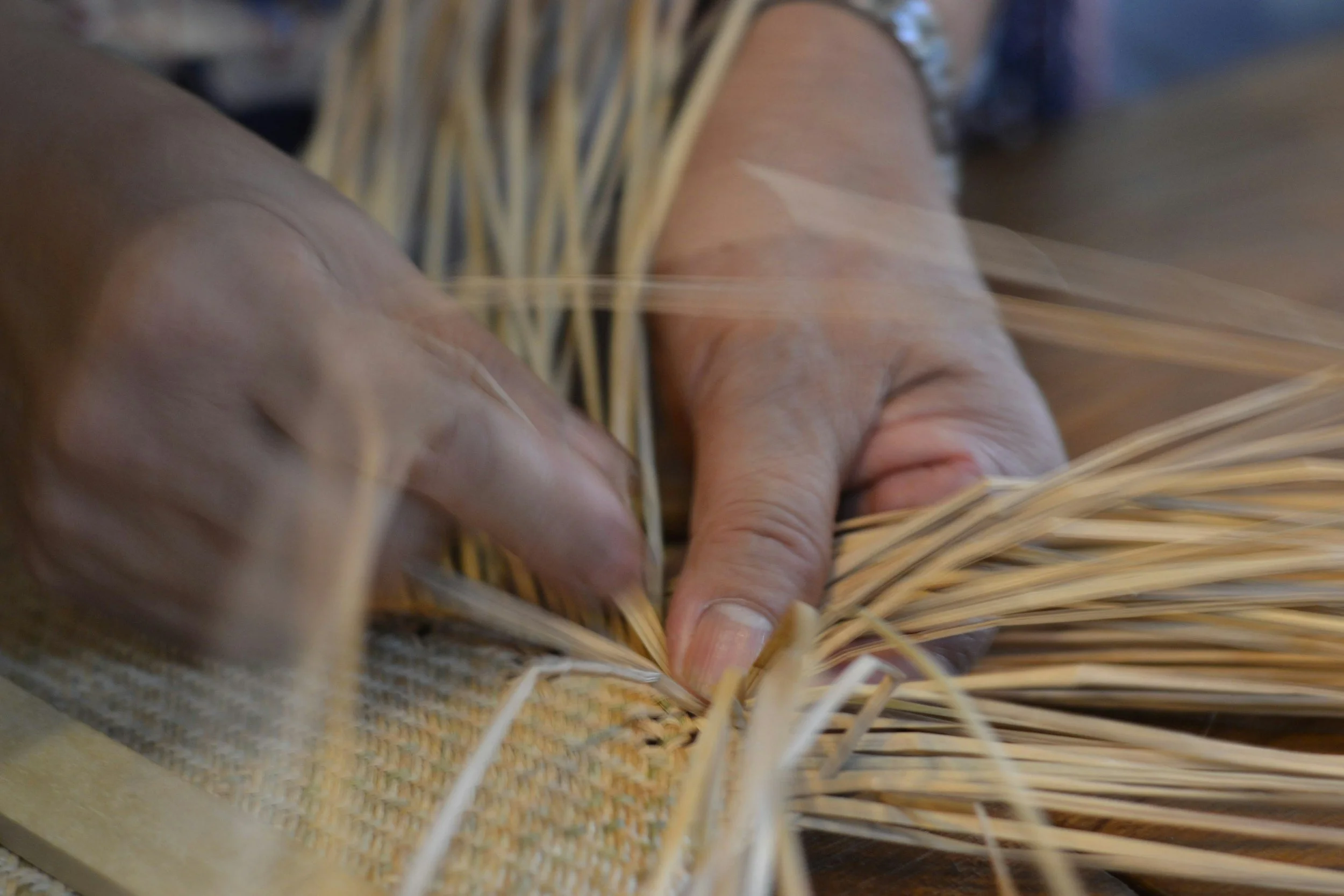
What Weaving Really Means
In the systems change space, "weaving" has become a popular term. Yet much of what we call weaving is simply connecting people. Drawing on Indigenous wisdom, this article explores weaving as something far deeper: the cultivation of the relational architecture that allows life, communities and organisations to truly thrive.
In recent years, the word weaving has become increasingly common in the world of systems change.
"We need more weavers."
"I'm a systems weaver."
"We're weaving ecosystems."
It is a beautiful word. It evokes relationship, interconnection and emergence. Yet I often wonder whether we have forgotten what weaving actually means.
Much of what is described as weaving today is, in reality, connecting. It is introducing people, building networks, hosting gatherings, following synchronicities and creating opportunities for collaboration. These are valuable practices. They create movement, conversations and possibility.
But movement is not the same as weaving.
If we are honest, many of these carefully curated networks dissolve as quickly as they emerge. Relationships remain shallow, collaborations fade, communities disperse, and promising initiatives struggle to create lasting impact. There is activity, but very little that truly holds. Ideas circulate, yet they rarely coagulate into structures capable of carrying life over time.
This is not because people lack good intentions. It is because connection alone does not create the conditions for life to endure.
Several years ago, while spending time in the Sierra Nevada de Santa Marta in Colombia, I encountered a profoundly different understanding of weaving.
For the Kogi, weaving is not simply a craft. The women weave mochilas, their traditional bags, but every thread carries meaning. The act of weaving connects the visible and invisible worlds. It honours the mountains, the rivers, the ancestors, future generations, the community, the plants, the animals, and every living relationship that sustains life. The weave becomes an expression of cosmology rather than an object of utility.
In many ways, the weave creates the living architecture through which life itself can move. It is the wiring that holds the relationships together.
Perhaps this is why, when you spend time in the Sierra Nevada, there is a feeling that is difficult to describe. The mountains feel alive. The rivers feel alive. The land itself seems to carry a presence. It is not simply because the landscape is beautiful. It is because the relationships between all living beings continue to be tended, generation after generation.
The weave is alive because the relationships are alive.
The men carry another complementary practice through the Poporo. To an outside observer, the Poporo appears to be a simple gourd containing powdered lime made from crushed seashells or limestone. Throughout the day, coca leaves are gently chewed while small amounts of the lime are added using a wooden stick. Over many years, the repeated movement of the stick around the neck of the Poporo slowly builds layer upon layer, leaving a visible record of a lifetime of contemplation, prayer and relationship.
Within Kogi cosmology, however, the Poporo is far more than an object. It is a daily practice of maintaining right relationship—with oneself, with the Earth, with thought, with responsibility and with the unseen world.
If the weaving creates the circuit, the Poporo maintains the current flowing through it.
One without the other is incomplete.
Current without a circuit (the weave) simply disperses. Energy without relationship cannot sustain itself.
Watching this helped me recognise something about our own culture.
The Western world has become exceptionally good at generating current. We produce ideas, innovation, technology, capital, vision, entrepreneurship and movement at extraordinary speed. We celebrate creativity, disruption and scale.
Yet we often attempt to send that current through broken circuits.
We build organisations before cultivating relationships capable of holding them. We create networks without shared stewardship. We pursue collaboration without tending trust. We launch movements before establishing the structures that allow communities to remain coherent over time.
Then we wonder why burnout is everywhere.
Why promising initiatives lose momentum.
Why organisations struggle to remain alive.
Perhaps the problem is not that we lack energy.
Perhaps we have forgotten how to weave.
True weaving is not about connecting more people.
It is about cultivating the relational architecture capable of holding life.
It asks different questions.
Which relationships require tending?
What structures allow trust to deepen over years rather than months?
What rhythms enable communities to remain coherent long after the initial excitement has faded?
How do we create something capable not simply of growing, but of sustaining life?
This work is rarely visible. It unfolds slowly, often unnoticed. It requires patience, presence, continuity and care. Above all, it requires stewardship.
The more time I spend working with founders, executives, artists, practitioners and communities, the more I realise that what we often call leadership is, in fact, the work of tending these relational fields. Organisations flourish when the relationships beneath them are healthy. Communities endure when the weave is continuously maintained. Change becomes regenerative when there is sufficient structure to hold its energy.
This understanding has become central to my own work. Through years of practice in Traditional Chinese Medicine, learning from Indigenous wisdom traditions, and accompanying leaders navigating complexity, I have come to see leadership less as the art of directing systems and more as the practice of stewarding the living relationships from which those systems emerge.
This is the foundation of the Operational Leadership framework. It is an invitation to move beyond managing organisations as mechanical structures and begin reading them as living systems—systems shaped by relationship, rhythm, timing and stewardship.
If these reflections resonate with you, I invite you to explore the Operational Leadership course. Together, we learn not simply how to lead organisations more effectively, but how to cultivate the conditions in which people, teams and communities can genuinely thrive.

The Relational Field: A New Way of Seeing Leadership
Most leadership challenges don't exist in isolation. They emerge from the relationships between people, teams, purpose, and the wider system. In this article, I explore the concept of the relational field and why leadership is less about controlling complexity and more about stewarding the living dynamics beneath it.
Leadership today is often approached as a series of separate challenges.
There is strategy.
Operations.
Culture.
Governance.
Personal wellbeing.
Relationships.
Family life.
When one of these areas becomes difficult, we naturally look for a solution within that domain. We hire a business coach to improve performance, a leadership coach to become more effective, a therapist to work on relationships, or a consultant to redesign the organisation.
Each intervention can be valuable.
Yet one question is rarely asked:
What if the challenge isn't located in one part of the system at all?
What if it emerges from the relationships between them?
Beyond Fragmented Leadership
The more responsibility we hold, the more interconnected our lives become.
As executives, founders and organisational stewards, we are rarely navigating a single challenge in isolation. Decisions made at work influence our relationships at home. Family transitions affect our leadership. Our inner state shapes the culture we create. Organisational pressures often reveal personal patterns we thought belonged elsewhere.
Life does not organise itself into neat categories.
It functions as a living system.
When we divide that system into separate coaching conversations, we often lose sight of the dynamics that actually shape our experience.
This is what I call the relational field.
What Is the Relational Field?
The relational field is the network of relationships that surrounds and sustains your life.
It includes your relationship with yourself, your partner, your family, your organisation, your colleagues, your purpose, your community, your environment, and even your relationship with time.
None of these relationships exists independently.
Each continuously influences the others.
When one part shifts, the whole field reorganises.
This is why the solution to a leadership challenge is often not found inside the organisation itself.
Sometimes what the organisation needs is for the founder to slow down.
Sometimes the tension between co-founders reflects an unspoken shift in the organisation's stage of development.
Sometimes what appears to be an operational issue is actually a question of trust.
And sometimes the greatest strategic decision is not deciding what to do next, but recognising what season you are in.
Learning to Read Patterns Instead of Problems
Most leadership development teaches us how to solve problems.
Few teach us how to recognise patterns.
Yet patterns are where wisdom lives.
A recurring conflict inside a leadership team is rarely about the meeting itself.
Repeated organisational bottlenecks are rarely caused by a single process.
Constant exhaustion is rarely solved through better time management.
These are symptoms.
The deeper question is:
What pattern keeps creating them?
When we learn to observe the relational field, we stop reacting to isolated events and begin to recognise the underlying movements that connect them.
The conversation shifts from:
"How do we fix this?"
to
"What is this revealing?"
This single shift transforms the quality of leadership.
Holding Space for What Is Emerging
One of the reasons I increasingly describe my work as stewardship rather than coaching is because stewardship begins with observation.
A steward does not immediately intervene.
A steward first learns to see.
They notice what is already alive.
They recognise where energy is flowing naturally and where it is being depleted.
They distinguish between what requires decisive action and what simply needs time to mature.
In many organisations, leaders are rewarded for speed.
Yet some of the most important decisions cannot be accelerated.
They require discernment.
Discernment is not hesitation.
It is the capacity to perceive the deeper order beneath visible events.
It is knowing the difference between a problem that requires intervention and a transition that requires patience.
Working With Living Systems
Nature offers a different model of leadership.
Nothing in nature grows continuously.
Every living system moves through rhythms of emergence, growth, maturity, release, rest and renewal.
Forests.
Rivers.
Human beings.
Organisations.
When we ignore these rhythms, we begin to force outcomes that are not yet ready—or hold onto structures whose time has already passed.
Many executives intuitively sense this.
They recognise that timing often determines the success of a strategy as much as the strategy itself.
The challenge is that modern leadership rarely offers a language for working with timing.
Instead, it rewards constant acceleration.
The consequence is that many leaders become extraordinarily effective at producing results while gradually losing their relationship with the living system they are trying to lead.
From Control to Stewardship
Stewardship invites a different orientation.
It asks us to move from controlling every variable towards cultivating the conditions in which life can organise itself intelligently.
This does not mean becoming passive.
It means becoming more perceptive.
More intentional.
More responsive.
It means recognising that leadership is not only about making decisions.
It is about learning where to place attention.
Because attention shapes perception.
Perception shapes decisions.
And decisions shape the future of every living system we are entrusted to lead.
A Different Kind of Practice
This is why the work I offer rarely focuses on only one dimension of life.
A conversation about organisational strategy may naturally lead to questions about partnership.
A discussion about operational structure may reveal personal patterns around trust or control.
A leadership decision may only become clear once the wider relational field has been acknowledged.
Rather than separating these conversations, we learn to hold them together.
Not because everything deserves equal attention, but because everything belongs to the same living system.
The goal is not to have perfect balance.
The goal is to develop the capacity to discern what is asking for stewardship now.
Seeing the Whole
Perhaps the greatest gift of working with the relational field is that leadership begins to feel less like carrying the weight of endless decisions and more like participating consciously in a living process.
You begin to recognise patterns before they become crises.
You stop confusing urgency with importance.
You learn to distinguish symptoms from root causes.
And gradually, leadership becomes less about managing complexity and more about cultivating coherence.
Not by controlling every part.
But by learning to see—and steward—the whole.
At LifeFlowTao, stewardship begins with a simple premise: before deciding what to do next, learn to recognise the living patterns already shaping your life, your relationships, and your organisation. When perception changes, leadership naturally follows.

Building an Operating System in Sync with Time: Lessons from the Book of Enoch
What if time isn’t something to manage—but something to align with? Drawing from the Book of Enoch, this piece explores how the sun, moon, and calendar reveal a deeper structure of reality—and how building in sync with that rhythm changes everything.
There’s a quiet assumption built into modern life: that time is something we manage, shape, and optimize. We break it into hours, fill it with tasks, and measure our worth by how efficiently we use it. But the ancient Book of Enoch offers a very different perspective—one that doesn’t treat time as a tool, but as a structure we are meant to align with.
That idea became the foundation for why I created an operating system based on nature’s rhythm, guided by the solar and lunar cycles.
In Chapter 72, the text describes the movement of the sun with striking precision. Its rising points shift throughout the year, its path changes gradually, yet it never deviates from its course. At first glance, this reads like early astronomy. But beneath that surface is something deeper. The sun becomes a symbol of reliability—of truth in motion. It does not react, it does not adjust, and it does not forget where it is meant to go. It simply follows its path, consistently and without exception.
There’s something grounding in that. It suggests that reality itself operates on principles that are not influenced by human preference or emotion. We often assume that our systems should adapt to us, but the sun presents the opposite idea: that we are the ones meant to align with what is already stable. This became the first principle in my work. Instead of building systems that react constantly to changing inputs, I began looking for what is fixed, what is dependable, what can serve as a foundation.
Then the text shifts its attention to the moon in Chapters 73 and 74. Unlike the sun, the moon is never the same. It grows, fades, disappears, and returns. It embodies change in its most visible form. But this change is not chaotic. It follows a rhythm so precise that it can be predicted far in advance. The phases repeat, the cycle renews, and even absence becomes part of a larger pattern.
This reframed how I think about variability. Change is often treated as disruption, something to manage or control. But the moon suggests that change itself can be structured. It doesn’t break order—it expresses it differently. That realization shaped the second layer of the system I built. Instead of forcing consistency across all moments, I began designing for cycles—recognizing that energy, focus, and creativity naturally rise and fall, and that different phases are suited for different kinds of work.
Chapter 75 brings an idea that might seem minor at first, but carries profound implications: the importance of a correct calendar. In the worldview of Enoch, timekeeping is not arbitrary. It is not just a practical tool for organizing life. It is a way of staying aligned with the underlying structure of reality. To measure time incorrectly is not just an error—it is a form of disconnection.
This shifted something fundamental in how I approached planning. Instead of imposing meaning onto time, I began asking what meaning time already holds. Modern systems often rely on artificial constructs—deadlines that ignore natural rhythms, schedules that disregard cycles of energy. But if time itself carries structure, then the goal is not to control it, but to move in harmony with it.
The text then introduces a warning in Chapters 76 through 79, and this is where it becomes especially relevant today. It speaks of people who will misunderstand these cycles, who will distort them, not just in calculation but in perception. And when perception is distorted, something deeper begins to break down. Patterns that are inherently ordered start to appear random. Structure becomes invisible. Reality begins to feel chaotic.
This feels familiar. We live in a world filled with information, yet often disconnected from meaning. The issue is not that order has disappeared, but that our ability to perceive it has weakened. This insight became central to the system I created. The goal is not to impose control, but to restore clarity—to see patterns as they are, rather than as they appear through a distorted lens.
In Chapter 80, the text describes a time when everything seems “off.” Cycles feel irregular, time feels distorted, and the natural order appears disrupted. But there is a subtle implication beneath this description. The disruption may not be in nature itself. It may be in the way humans are relating to it.
This resonates deeply with the modern experience. When life feels rushed, fragmented, or misaligned, the instinct is often to fix the external world—to reorganize, to optimize, to push harder. But what if the issue is not external at all? What if it’s a matter of being out of sync with something more fundamental?
Chapters 81 and 82 bring this section to a close by emphasizing the importance of passing on this knowledge. But there is a clear acknowledgment that not everyone will understand it, and not everyone will act on it. This highlights a crucial point: awareness alone is not enough. Understanding patterns intellectually does not create alignment. It has to be lived, applied, embodied.
One of the most powerful ideas running through this entire section is that time itself carries meaning. There is a right moment for things to unfold, a sequence that matters, a rhythm that cannot be ignored without consequence. This introduces a different way of thinking about action. It’s not only about what is done, but when it is done. Even the right action, taken at the wrong time, can lead to disorder.
This idea changed how I approach decisions. Instead of focusing solely on what needs to be done, I began paying attention to timing—looking for alignment rather than forcing outcomes.
What emerges from these chapters is not just a description of the cosmos, but a framework for living. The sun offers stability. The moon offers cycles. The calendar offers structure. Together, they form a system that is already in place, whether we recognize it or not.
The operating system I built is simply an attempt to engage with that reality more consciously. It is not about control, and it is not about perfection. It is about alignment. About recognizing that life has rhythm, that patterns exist, and that moving in harmony with them reduces friction in a way that no amount of optimization ever could.
At its core, this approach is simple, but not easy. It asks for a shift in perspective—from seeing time as something we use, to seeing it as something we participate in.
The universe, as described in the Book of Enoch, is ordered. Nature reveals that order. Time sustains it.
The question is not whether that structure exists.
The question is whether we are willing to live in alignment with it.

The Half Magician and the Half Priestess: The Inner Work Behind System Change
Many of today’s change-makers are still operating from what we might call the Half Magician or the Half Priestess: gifted, visionary, and well-intentioned, but not yet fully embodying the power they carry. This article explores the healing arc from domination to stewardship, from sensitivity to grounded action, through myths like Midas, Merlin, Androcles, Persephone, and Psyche — and what they reveal about regenerative leadership, impact investing, and the future of system change.
In every period of collapse and renewal, there are people trying to build a new world. They are creating regenerative businesses, new financial models, alternative ownership structures, climate technologies, impact funds, healing communities, and more conscious ways of living. They want to move away from extraction and toward stewardship. And yet, so many of these efforts eventually recreate the very systems they were trying to replace. The language changes. The branding changes. The aesthetics change. But beneath the surface, the same dynamics remain: ego, control, hierarchy, performance, avoidance, moral superiority, burnout, domination, and the need to be right. Why? Because systems do not emerge only from ideas. They emerge from the consciousness of the people designing them. This is why the archetypes of the Half Magician and the Half Priestess matter so deeply right now. They help us understand why so many intelligent, sensitive, visionary people still struggle to create change that lasts.
The Half Magician
The half magician is intoxicated by power. Not necessarily political power or greed in its obvious form. More often, it appears as the desire to be exceptional. To be the founder with the best idea. The investor who sees the future first. The systems thinker with the deepest framework. The climate entrepreneur with the most elegant solution. The person who can fix, optimize, disrupt, scale, or save. The half magician often wants to help. But beneath the help is still a hidden need to be the hero. This is why so many impact spaces unconsciously recreate the old world. We see founders speaking about decentralization while centralizing power around themselves. We see impact investors speaking about stewardship while still relating to companies, ecosystems, and communities as things to manage, own, or optimize. We see sustainability leaders who replicate extraction internally through overwork, burnout, urgency, and control. We see regenerative language wrapped around fundamentally non-regenerative behavior. The half magician does not seek relationship. The half magician seeks mastery.
Hercules, Androcles, and the Lion
One of the clearest images of this journey is the movement from Hercules to Androcles. Hercules proves himself by overpowering the lion. He wrestles it, kills it, and wears its skin as a symbol of his strength. This is the old paradigm of power. Nature is something to dominate. Complexity is something to conquer. Leadership is something proven through force. Androcles represents an entirely different relationship. He does not conquer the lion. He removes the thorn from its paw. He recognizes that beneath the threat is pain. And because he responds with care instead of domination, the lion becomes an ally rather than an enemy. This is the deeper movement required for system change. Real stewardship does not come from overpowering people, markets, ecosystems, or organizations. It comes from understanding what pain sits underneath the behavior. A regenerative leader is not someone who can dominate complexity. A regenerative leader is someone who can listen deeply enough to transform their relationship with it.
The Healing Arc of Midas
King Midas is one of the most important myths for today’s financial world. Midas is given the power to turn everything he touches into gold. At first, this seems like the ultimate gift. Infinite value. Infinite wealth. Infinite proof of success. But quickly, the gift becomes a curse. Food turns to gold. Relationships turn to gold. Life itself becomes untouchable. Midas discovers that the obsession with value extraction destroys the very thing that is valuable. This is where many modern systems are still trapped. In impact investing, sustainability, philanthropy, and social innovation, there is often a hidden Midas impulse: How do we scale this? How do we measure this? How do we maximize this? How do we prove this works? How do we extract more value from this? Even when the language is ethical, the underlying relationship can still be extractive. Everything becomes a KPI. A metric. A dashboard. A return. A brand. Midas teaches that not everything valuable can be measured. And not everything that can be measured is valuable. The healing arc of Midas begins when he realizes that gold cannot feed him. Gold cannot hold him. Gold cannot love him. He must wash the gift away. In modern terms, this means moving from extraction to relationship. From ownership to stewardship. From maximizing value to cultivating aliveness.
The Healing Arc of Merlin
Merlin begins as the gifted strategist, the seer, the architect of kingdoms. He understands power. He influences kings. He shapes destiny. He knows things others do not know. In today’s world, Merlin appears in visionary founders, brilliant investors, systems thinkers, futurists, and intellectual leaders. These are people who can see patterns before others do. They know where the world is going. They understand systems. They understand leverage. But the half-magician version of Merlin becomes trapped in needing to be the one who knows. The one behind the curtain. The indispensable advisor. The architect of the future. This often creates leaders who are admired but isolated. People who are deeply insightful but disconnected from ordinary life. People who know how to design systems but do not know how to relate. Merlin’s healing begins when he leaves the court and returns to the forest. In many stories, he becomes wild, stripped of status, broken open by grief and war. The forest symbolizes a different kind of intelligence. Not the intelligence of control. The intelligence of listening. The intelligence of interdependence. The intelligence of nature. Merlin’s final lesson is that he cannot remain the all-knowing figure forever. He must eventually pass on what he knows. He must step aside. This is perhaps one of the deepest lessons for modern leaders. Real stewardship means building systems that do not depend on your brilliance. The mature magician is not the one who remains at the center. The mature magician creates conditions for others to thrive.
The Half Priestess
If the half magician is intoxicated by power, the half priestess is intoxicated by sensitivity. She sees what others do not see. She feels what others do not feel. She is drawn toward healing, mystery, spirituality, ethics, beauty, grief, and depth. But when only half embodied, she becomes disconnected from grounded action. She remains in symbolism instead of structure. In critique instead of creation. In purity instead of participation. We see this in modern regenerative and activist spaces too. We see endless conversations about embodiment with no real action. We see communities that speak beautifully about interdependence but cannot handle conflict. We see leaders who are deeply intuitive but cannot make decisions. We see people who are so attached to being sensitive, ethical, or conscious that they become unable to negotiate, organize, build, or lead. The half priestess mistakes distance for wisdom. But wisdom is not remaining untouched by the world. Wisdom is entering the world fully without losing what is sacred.
Persephone: Learning to Move Between Worlds
Persephone begins as the innocent maiden. Then she is taken into the underworld. At first, she belongs nowhere. She is no longer fully of the world above, but she is not yet sovereign in the world below. This is the experience many sensitive people have today. They no longer fit into the dominant systems. But they do not yet know how to create a new one. Persephone becomes whole not by choosing one world over the other. She becomes whole by learning to move between them. She becomes a bridge. This is the mature priestess. Someone who can sit in a boardroom without losing their soul. Someone who can understand finance without worshipping money. Someone who can work inside institutions without becoming trapped by them. Someone who can move between vision and execution, spirit and structure, grief and action.
Psyche: The Priestess Who Learns to Build
Psyche begins as a figure of beauty, longing, and devotion. But she is passive. She is carried by circumstance. She does not yet know her own strength. Then come the trials. She must sort seeds. Gather impossible materials. Descend into the underworld. Discern what belongs where. Psyche’s journey is essential for today’s regenerative movements because it reminds us that sensitivity alone is not enough. Love is not enough. Vision is not enough. At some point, the priestess must learn to organize. To discern. To build. To negotiate. To lead. Psyche becomes whole not because she feels deeply. She becomes whole because she learns to act with precision.
What True System Change Requires
The systems we inherited were largely built by the shadow magician: obsessed with control, conquest, scale, extraction, certainty, and dominance. In response, many people moved toward the priestess: toward care, slowness, intuition, healing, community, and spirituality. But neither archetype is enough when only half embodied. The half magician creates brilliant systems that still reproduce ego and hierarchy. The half priestess creates beautiful visions that never become reality. We need both archetypes fully alive. We need magicians who can wield power without being possessed by it. We need priestesses who can hold mystery without withdrawing from responsibility. The future will not be built only by better technologies, policies, or business models. It will be built by people who have transformed their relationship to power itself. Because every new system eventually mirrors the emotional maturity of the people who created it. And if we do not transform ourselves, we will keep rebuilding the same world with more beautiful language.

You Built It Fast. Now It Can’t Hold.
What makes founders successful individually often creates friction in teams.
When urgency becomes the operating system, organisations struggle to sustain performance.
There is another way — one based on rhythm, timing, and balance.
There is a pattern I have seen repeatedly over the past decade working with founders, entrepreneurs, and leaders.
And once you see it, you cannot unsee it.
The Founder’s Advantage
Most founders don’t succeed because they follow structure.
They succeed because they can move without it.
They think on their feet.
They make decisions quickly.
They operate under pressure.
They can hold complexity, uncertainty, and intensity — often better than most.
This ability to move fast and deliver under pressure is what allows something to exist in the first place.
It is the spark behind innovation.
Where It Starts to Break
But something shifts the moment a founder begins to build with others.
What worked individually
starts to create friction collectively.
Priorities shift late.
Decisions come under pressure.
Clarity is not always available when others need it.
The system begins to rely on the founder’s capacity to hold intensity.
And over time, something subtle happens:
The project starts taking the shape of the founder’s nervous system.
The Hidden Dynamic: The System Mirrors the Leader
Every organisation develops what I call an “external nervous system.”
It is not written anywhere.
But it is felt everywhere.
It shows up in:
– how decisions are made
– how urgency appears
– how pressure builds
– how teams relate to time and execution
If the founder operates in urgency,
urgency becomes the baseline.
If decisions happen late,
the system learns to wait until pressure forces action.
If reflection is skipped,
the system loses its ability to self-correct.
Why This Becomes Unsustainable
The founder can often hold this.
But the team has to live inside it.
And that is where the consequences begin to appear:
– tension
– stress
– fatigue
– disengagement
Not because people are not capable.
But because the system itself is difficult to regulate.
Many startups and high-growth environments fall into this pattern.
Not due to lack of intelligence.
But because the operating system is never designed — it emerges from behaviour.
Why More Support Doesn’t Fix It
At this stage, most organisations try to compensate.
They add:
– better communication
– more structure
– more support
All useful.
But insufficient.
Because the issue is not the amount of support.
It is that the system has no clear phases.
Everything happens at once.
Execution, decisions, adjustments — compressed into urgency.
The Missing Piece: Rhythm
In nature, no system operates in constant output.
There are phases:
Growth.
Expression.
Consolidation.
Rest.
Ancient civilisations understood this deeply.
Agriculture, rituals, governance, and even architecture were aligned with lunar and solar cycles.
These cycles were not symbolic.
They were operational frameworks.
They provided:
– timing
– sequencing
– predictability
– regeneration
They ensured that energy was not only used —
but restored.
What We Lost
Modern organisations inherited models designed for:
– industrial production
– efficiency
– constant output
They removed cycles.
They removed pauses.
They removed rhythm.
And replaced it with:
continuous pressure
continuous growth
continuous urgency
This works — for a while.
But no biological system can sustain permanent activation without consequences.
Pressure Is Not the Enemy
Pressure is not inherently negative.
In fact, it is necessary.
Moments of intensity create movement, breakthroughs, and results.
But pressure is meant to be cyclical, not constant.
Without phases of:
– reflection
– integration
– recovery
pressure stops being productive.
It becomes extractive.
Why This Matters Now
If we want to build organisations that contribute to a more sustainable and regenerative world,
we cannot continue operating on extractive internal systems.
We cannot create regenerative solutions externally
while running on depletion internally.
The way we organise ourselves
is part of the solution.
A Different Operating System
This is what led me to create Organisational Rhythms.
A leadership framework grounded in two natural cycles that have structured life for centuries:
🌙 Lunar cycles (internal rhythm)
☀️ Solar cycles (external rhythm)
The lunar cycle follows a monthly rhythm — from new moon to full moon and back — traditionally associated with internal processes: reflection, sensing, adjustment, and integration.
Applied to organisations, it structures the inner life of work:
– how teams align
– how decisions mature
– how friction is surfaced and resolved
– how learning is integrated
It introduces clear internal phases:
– align → clarify intention and direction
– act → move forward and build momentum
– adjust → respond to friction and recalibrate
– integrate → reflect, learn, and consolidate
Instead of pushing continuously, teams move through cycles of action and reflection — which improves clarity and reduces reactive decision-making.
The solar cycle follows a yearly rhythm — marked by equinoxes and solstices — and has historically guided agriculture, planning, and collective activity.
It structures the outer life of work:
– when to initiate projects
– when to expand and scale
– when to consolidate and refine
– when to close cycles and reset
– Spring (Equinox) → initiate, set direction
– Summer (Solstice) → expand, express, grow
– Autumn (Equinox) → consolidate, prioritise
– Winter (Solstice) → close, rest, reset
It brings a longer-term perspective, allowing organisations to pace their efforts instead of operating in constant acceleration.
Together, these cycles introduce something most organisations lack:
timing.
Not just what to do —
but when to do it.
Because many teams are not doing the wrong things.
They are doing the right things
at the wrong moment.
When timing improves:
– decisions require less effort
– friction is addressed earlier
– energy is used more efficiently
– performance becomes sustainable
From Urgency to Rhythm
When teams begin to operate in cycles:
– decisions are made with more clarity
– friction is addressed earlier
– energy is renewed instead of depleted
– performance becomes sustainable
The system no longer depends on one person’s capacity to hold pressure.
It becomes self-regulating.
The Real Shift
This is not about slowing down.
It is about working differently.
From:
constant urgency
→ structured rhythm
From:
reactive decisions
→ well-timed action
From:
burnout cycles
→ regenerative performance
What You Build Needs to Hold
At some point, every founder reaches this moment:
The question is no longer:
“How do I push this further?”
But:
“Can what I’ve built actually hold?”
Because what you build will eventually have to sustain:
– your team
– your energy
– your vision
Build Accordingly
If you are in that moment,
and you recognise this pattern,
then you are not at the beginning.
You are at a turning point.
What you build will eventually have to hold.
Build accordingly.
Explore the full course
A structured path to move from urgency to rhythm — and build a system that can actually hold.
The Three-Circle Framework: Remembering How Institutions Can Serve Life Again
Our modern institutions are failing not because of bad intentions, but because they have lost a universal balance that life itself depends on. This article explores the ancient three-circle framework — wisdom, stewardship, embodiment — found across cultures worldwide, and shows how restoring this pattern can help institutions and leaders return to coherence, vitality, and truly life-serving action.
Across Indigenous cultures in Australia, Africa, South America and beyond, a simple geometric pattern appears again and again: three interdependent circles. Though named differently across cultures, these circles always represent the same universal functions required for any living system — human or institutional — to stay healthy.
This pattern is not symbolic.
It is architectural.
It is the geometry through which life organises, heals, and sustains itself.
And today, as many of our modern systems break down, the relevance of this architecture has never been clearer.
What Indigenous cultures have long understood — and what our institutions have forgotten — is that a system cannot function unless its three layers are in coherence, just as the human being cannot thrive unless mind, body, and soul are aligned.
This is the lens through which we can understand the breakdown of our institutions — and the pathway to regenerate them.
A Universal Pattern: Wisdom → Stewardship → Embodiment (Soul → Mind → Body)
No matter the culture or continent, the three circles reflect a consistent triad:
1. The Circle of Wisdom (Soul)
The deep orientation that holds meaning, values, cosmology, and ancestral knowledge.
This is the layer that answers the question:
What do we serve?
Without soul, action loses purpose. Systems drift into extraction, fragmentation, and burnout.
2. The Circle of Stewardship (Mind)
The integrative layer that translates wisdom into responsible structures.
Stewardship is governance in its original meaning: care, continuity, coherence.
Without mind, wisdom cannot move into form. We get idealism without pathways.
3. The Circle of Embodiment (Body)
The layer where impact becomes real — in soil, water, community, livelihoods.
Without embodiment, strategy remains theoretical. Nothing changes on the ground.
Just as a human being suffers when mind, body, and soul fall out of alignment, institutions decay when these three systemic circles drift apart.
This is the deeper reason for the stagnation, confusion, and internal cannibalisation we see today.
Institutional Necrosis: When Systems Serve Themselves Instead of Life
Many modern institutions behave like bodies that have lost connection to their own intelligence:
Soul is missing: No clear purpose, no ethical orientation, no connection to life.
Mind is overwhelmed: Governance becomes self-protective rather than life-protective.
Body is disconnected: Impact is minimal, abstract, or performative.
When mind, body, and soul no longer communicate, the living system collapses inward.
In biological terms, this is called necrosis — a process where tissue stops serving the body and begins consuming itself.
This is what happens when institutions stop serving life and begin serving their own preservation.
The problem is not in the people.
It is in the architecture.
The Three-Circle Framework as a Diagnostic Tool for Systemic Investment
This ancient triadic model gives us a powerful, practical lens for modern work:
Are all three layers active and aligned?
If not, the system will eventually fail — no matter how much capital, strategy, or technology we add.
For systemic investment, this framework becomes essential:
Wisdom (Soul): Is the initiative anchored in deeper orientation, values, ancestral intelligence?
Stewardship (Mind): Is the governance coherent, caring, and capable of holding a transition?
Embodiment (Body): Will the investment produce real-life regeneration on the ground?
Just as a medical practitioner cannot heal the body without addressing mind and soul, a systems practitioner cannot regenerate institutions by focusing only on one layer.
Healing requires coherence.
Regeneration requires alignment.
Transformation requires that all three circles are engaged.
Why This Matters Now
We are living through a moment where the old institutional paradigms — linear, hierarchical, extraction-driven — can no longer sustain the complexity of our world.
Their architecture is collapsing because:
there is no shared wisdom to guide them,
governance has become defensive rather than caring,
embodiment has been replaced by abstraction.
The three-circle framework does not offer a “new model.”
It offers a remembered model — one carried through millennia, across continents, by cultures that understood how to maintain coherence with life.
It reminds us that institutions, like human beings, must be treated as living systems.
They must have a soul.
They must have a mind.
They must have a body.
And these three must be in relationship.
Closing: Returning Institutions to Life
The crisis we face is not the breakdown of systems — but the breakdown of coherence.
Institutions do not fail because the world is too complex.
They fail because they are no longer aligned with the architecture of life.
Wisdom without stewardship collapses.
Stewardship without embodiment stagnates.
Embodiment without wisdom degrades.
But when soul, mind, and body come back into alignment, systems regenerate — naturally, coherently, and sustainably.
Three circles.
One architecture.
A pathway for institutions to serve life again.

Discovering Wu Wei: A Journey of Purpose, Embodiment, and Flow
Wu wei, the Taoist concept often translated as "non-action" or "effortless action," has fascinated me since the start of my journey. It seemed so simple—a state of flow, where one moves in harmony with the natural order. But over the years, I’ve come to realize that understanding wu wei is a lifelong process. Every time I felt I had grasped it, the meaning evolved, drawing me deeper into what it means to live a life of true purpose and alignment.
My journey began with kung fu, where I learned the importance of deliberate movement, discipline, and intent. A car crash left me with lasting tension and rigidity in my spine—a physical reminder of the impact that will probably never fully leave my body.
The polarity between this ingrained tension and the art of letting go has become one of my life’s deepest learning. As I advanced in kung fu, I noticed something subtle yet profound: when I moved with rigid intent, there was effort, and sometimes resistance. The more I tried to control, the more my body reminded me of its limits. But in the quiet moments, when I allowed myself to move without forcing, I tasted a fleeting sense of flow—a glimpse of wu wei.
I was learning that there is a difference between moving with intent and being moved by something beyond it, allowing universal flow to carry you, even when the body resists.
Seeking more, I delved into qigong, a practice that deepened my understanding of energy and its place in the body. Here, I began to explore the idea of surrender—of letting go of control and simply allowing energy to flow. At times, it felt like a dance, where my body was both mover and moved. I could feel the universal energy coursing through me, guiding me, showing me that true power lies not in forcing but in yielding, in embracing the wisdom that already resides within us.
As my journey continued, I studied acupuncture and various holistic practices, drawn to the art of healing. Working with people facing physical and emotional challenges, I initially felt the responsibility to “heal” them. Yet, time and again, I saw that real, lasting change only occurred when I could guide people back to themselves, to their own innate power to heal. My role was not to fix but to empower, to support the transformation that came from within. Here again, wu wei revealed itself: healing that happens not “doing” but by creating a space for natural, effortless transformation.
The Tao Te Ching became my companion throughout this journey. Each time I read it, I discovered new layers of wisdom, sometimes in passages I thought I already understood. One passage would resonate deeply, only to reveal a different meaning later, mirroring the changes I was experiencing in my life and practice. It was as if the text itself was alive, a reflection of the endless flow and change inherent in wu wei.
But it wasn’t until I began embodying my own gifts and purpose that wu wei truly began to transform my life. By aligning with my inner purpose, I felt a profound shift: my inner world started to impact my outer world in ways I hadn’t anticipated. Synchronicity appeared as if by magic, with opportunities, people, and events coming into my life effortlessly, all aligned with my purpose.
Wu wei, I realized, is allowing our inner light to illuminate our outer world, where our actions flow from the purest source within us.
It’s a journey that’s always evolving, always asking more of me and yet less of my control. When we live from our deepest purpose, action becomes effortless—an expression of who we truly are. This is what I feel guided to teach in my Life Flow Mastery program, guiding people to connect with their own inner flow, to discover and embody their purpose, and to let that purpose move them effortlessly.
If you feel drawn to embodying your own purpose and stepping into a life of natural flow, consider where this journey could lead you. Imagine how your inner alignment, nurtured over nine months of dedicated guidance, could ripple into every facet of your life. Through Life Flow Mastery, you can experience the power of wu wei as a lived reality—one that brings synchronicity, ease, and fulfillment, allowing you to not only feel your purpose but to let it shape your world.
Take a moment to explore what’s possible on this path of deep connection and transformation. Discover how your own light, fully embodied, might illuminate new horizons.

The Importance of Integrating Nature's Rhythms and Elements into How We Organize Ourselves
As a practitioner of Traditional Chinese Medicine (TCM) for over a decade, I have been deeply immersed in an ancient wisdom that seeks to balance the mind, body, heart, and spirit. TCM is a holistic system rooted in the principles of yin and yang, the five elements, and the interconnectedness of our inner and outer worlds. These concepts are not merely theoretical but serve as practical tools for fostering harmony within ourselves and, by extension, the organizations and communities we are part of.
The Foundations of Traditional Chinese Medicine
TCM views health as a dynamic balance between opposing forces—yin and yang—and the harmonious flow of vital energy (Qi) through the body. The five elements—Wood, Fire, Earth, Metal, and Water—represent various aspects of nature and human experience, each linked to specific organs, emotions, and seasons. TCM also emphasizes the relationship between our internal state (thoughts, emotions, physical health) and our external environment (seasons, relationships, the natural world), promoting a holistic approach to well-being.
Bridging Ancient Wisdom with Modern Leadership
As my practice evolved, I noticed that many of those seeking my services were change-makers—philanthropists, CEOs, and leaders of transformative businesses. These individuals, often at the forefront of innovation, found themselves struggling with burnout and disconnection. This observation led me to apply TCM principles beyond individual health to organizational and societal well-being. Just as TCM aims to restore balance within the body, I saw the potential to restore balance within organizations by aligning them with nature's rhythms and elements.
The Modern Crisis: Disconnection from Nature
Our society has long treated nature as something separate from ourselves—an entity to be controlled and exploited. This disconnection has led to the overuse of Earth’s resources and widespread ecological imbalance. Integrating TCM principles into how we organize ourselves could be transformative. By reconnecting with nature's rhythms, we can foster a regenerative approach to business practices, creating a ripple effect that benefits both people and the planet.
Three Key Elements for a Regenerative Organizational Ecosystem
Aligning with Natural Rhythms:
Beyond the seasonal focus of TCM, many ancient cultures emphasized the importance of aligning with the cycles of the moon and sun. Organizations can benefit by integrating these natural rhythms into their operations. For example, implementing a governance structure that follows the lunar cycle can promote regular reflection and goal-setting, with new moon meetings for setting intentions and full moon gatherings to celebrate achievements. Complementing this with solar cycles—aligning key business activities like strategic planning and performance reviews with the equinoxes and solstices—ensures that the organization operates in harmony with both its internal dynamics and the external environment.
Balancing Yin and Yang in Leadership:
The TCM concept of balancing yin and yang can be applied to organizational leadership by establishing a yin and yang CEO duo, supported by a council of leaders embodying these complementary forces. The yin leader nurtures organizational culture and emotional intelligence, while the yang leader drives strategic initiatives and external growth. This balance ensures that the organization remains both internally cohesive and externally dynamic.
Incorporating the Five Elements into Organizational Structure:
Structuring an organization around the five elements allows each aspect of the business to be nurtured according to its natural properties. For instance, the Wood element, governing growth and creativity, could oversee innovation and product development, while the Earth element, associated with stability and nourishment, might focus on operations, HR, and resource management. By aligning departments with the appropriate elements, organizations can create a harmonious ecosystem where each part supports and regulates the others, mirroring the natural cycles in TCM.
Can We Lead with Nature in Mind?
In a world increasingly out of balance, where the separation between humanity and nature has led to ecological and societal crises, it is vital to reconnect with the wisdom of the natural world. By integrating the rhythms and elements of nature into our personal lives, businesses, and communities, we can begin to heal these divisions and create a more regenerative and harmonious future.
As practitioners, leaders, and change-makers, it is our responsibility to seek balance within ourselves and extend that balance to the ecosystems we are part of. By doing so, we can create organizations that are not only successful but also sustainable, nurturing the well-being of both people and the planet.